


David Moura-George has spent nine years advising investors on Portuguese property and now leads Athena Commercial, which sources hotels, logistics, development land and school sites for international buyers, and assembles club deals when an opportunity justifies several investors. Rodrigo Machaz trained with Four Seasons, studied asset management at Cornell and founded Memmo Hotels in July 2006. 20 years on, Memmo runs three hotels in Lisbon and the Algarve, with five more in development. When the two sat down to discuss what international capital needs to know about the market, their conversation kept returning to one subject: licensing.
Nine months, or ten years
On 1 August 2006, Machaz took over a 1960s hotel above the fishing harbour at Sagres, on the south-western tip of the country, where he had surfed and dived since boyhood. He kept the old hotel trading through the summer to generate cash, closed its doors at the end of September and reopened the following July as Memmo Baleeira, fully renovated and repositioned as a four-star base for guests who come to walk, surf and explore the Vicentine Coast. Nine months, keys to relaunch. Black-and-white photographs of the old hotel still hang on its walls.
In Lisbon, the same company's conversion of the Convento de Santa Mónica into a 123-room five-star hotel spent more than a decade clearing its approvals, entangled with archaeology and the câmara municipal. "The biggest challenge you don't control is the licensing process," Machaz says. "It can be very fast or very slow, depending on where you are and on the moment." Same operator, same architect, same country. The difference was not the building. It was the permission.
Together, Moura-George and Machaz have mapped what a hotel acquisition in Portugal should take: eight months to search, screen and negotiate, then viability, design and licensing, and 10 months to procure and finance. The benchmark is drawn from experience. At Baleeira, Machaz found the deal in three months, proved it in one and completed design and licensing in six. The margins are generous by design, because in Portugal the schedule is the first thing the system tests.
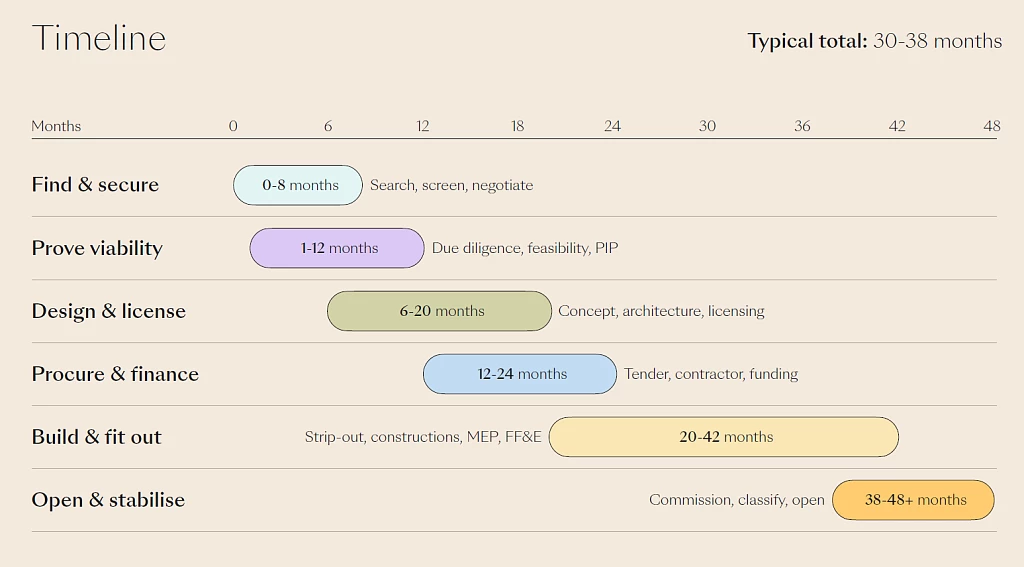
A country of small vetoes
Portuguese development consent is not one decision but a sequence of them. The Agência Portuguesa do Ambiente rules on water. Archaeologists rule on what lies beneath. Natural park authorities rule on what lies around. Each of these micro-institutions, as Machaz describes them, has the power to stop a project, and none answers to the others. The result is not so much a slow system as an unpredictable one.
Machaz calls it roulette. The câmara of Silves approved Memmo Arade, his vineyard hotel on the River Arade in the inland Algarve, quickly and with evident enthusiasm. Lisbon extended no such courtesy to the convent. The cycle matters as much as the map. When Memmo arrived in Alfama, as the first hotel in the old town, municipalities courted investment and contractors competed for work. Today, with more than a hundred hotel projects under development or awaiting approval in Lisbon alone, the difficulty is finding a builder at all, let alone one who will guarantee price, quality and timing.
Machaz, who learned this coastline on a surfboard, frames the risk in the terms he knows best: "It's like going surfing when you don't know the conditions. It could be 20 metres, it could be 5 metres, or flat. When you go into the ocean, you need to be prepared." Moura-George names the other conditions investors must read: heavy labour costs and taxation, and market data still thinner than institutional capital expects. Most investors price all of this as friction. It is better priced as a barrier to entry, and barriers protect whoever is already inside.
More guests than runways
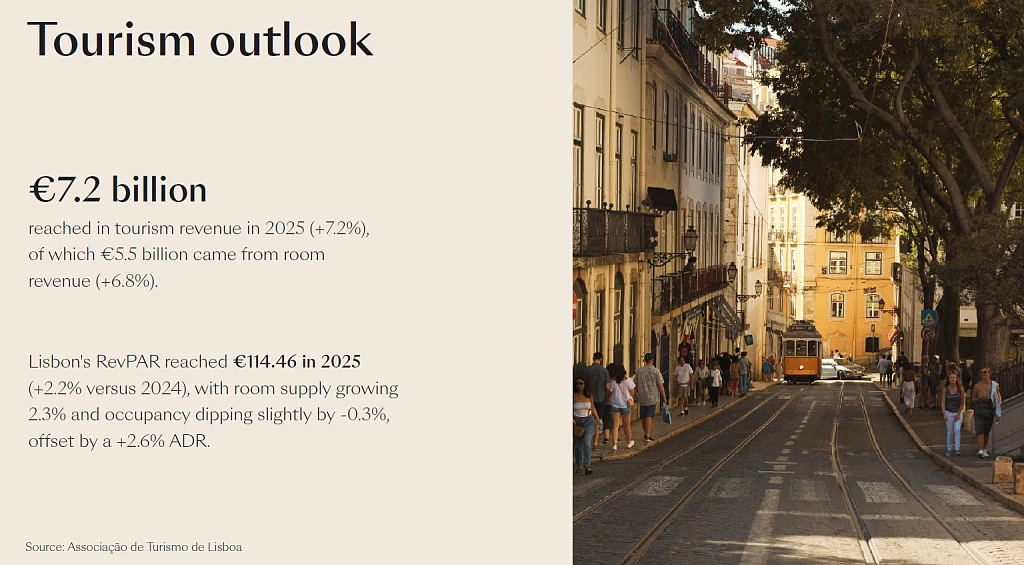
Demand is not in question. When Moura-George returned to Portugal from Brazil, the country welcomed 10 to 15 million visitors a year. It now receives almost 35 million and records close to 90 million overnight stays, in a country of 10 million people; 67% of guests are non-residents. Portugal’s tourism revenue reached €7.2 billion in 2025, and Lisbon’s RevPAR stands at €114.46. Americans, a marginal presence a decade ago, now account for almost 10% of foreign overnight stays. Capital has drawn its own conclusion. CBRE's European Hotel Investor Intentions Survey 2026 ranks Portugal fourth in Europe for hotel investment and Lisbon sixth among its cities, and €512 million flowed into Portuguese hotels in the first half of 2026, 96% of it from abroad.
Supply answers slowly, and expensively. New hotels in Portugal now cost around €300,000 a key, by Machaz's reckoning, before a single guest arrives. The building is also only half the problem. "You can have a beautiful hotel, but that's the hardware. You need to put the software in, and the software in the hotel business is people," he says. Short-term letting has absorbed the houses that seasonal staff once rented all year, so staff housing has to be solved before opening, not after. At Baleeira, Memmo bought a plot and built a house of three apartments for its directors and chefs. In Madeira, it is already searching for staff accommodation. In Comporta, Machaz calls housing the single greatest challenge.
The third constraint is overhead. Lisbon's Humberto Delgado airport is already stretched, and ANA's latest plan places the opening of its successor at Alcochete in mid-2037, with the government pressing for 2035. Roughly 30% of those landing in Lisbon travel elsewhere, which makes the capital a hub for the whole country. For the first time in 20 years, Machaz admits to pessimism: "The demand is there, but if there's no way to fly in..." Air links decided Memmo's island strategy. Compare the connections to Madeira with those to the Azores, he says, and the choice makes itself. "I don't want to be a pioneer. The pioneer is the guy who goes there, fights, fights, fights, plants the flag and then dies. I want to be at the front, but not the pioneer, because I know the cost of being a pioneer is huge."
When arrivals, workers and builders all grow more slowly than the pipeline of beds, the rooms already licensed, staffed and trading keep the demand.
The second life
This explains Memmo's next move. At Paul do Mar, a surfing village at the end of the road on Madeira's south-west coast, the company has acquired a bankrupt hotel with its licence intact. Surfers once called this stretch the Hawaii of Europe; most Madeirans have never been. The plan is 60 rooms, reworked by the architect Samuel Torres de Carvalho in the local volcanic stone so that the building reads as part of the cliff, with works due to start in January. "When you take over a hotel," Machaz observes, "you don't need to go through all the pain of licensing." Asked to choose between an empty plot and an existing building with potential, he takes the building every time. He renovates rather than pours concrete, and he regards a hotel's past as part of its value.
The operator's model is shifting to match. Machaz learned at Cornell that America's largest hotel owners are insurance companies, and that the industry has moved from owner-operators to asset-light operators paying rent, and then to operators who own neither the building nor the payroll, as Four Seasons has done for three decades. Portugal is now making the same journey. Of Memmo's five new projects, only one follows the owner-operator pattern of Baleeira. The rest pay rent to owners, one of them the Church, or run hotels under management contracts while the owner keeps the P&L. For Moura-George's clients, that opens a clear role: acquire the asset, bring in the operator at design stage, and hold the property while a brand fills it.
The competition for that role is sharpening. International brands such as The Standard are arriving in Lisbon and Comporta, and American investment trusts have followed American tourists. "In the past it was an easy walk," Machaz says. "The future will belong more to the professionals." His one piece of advice is two words long: be careful.
For patient capital, the implication is clear. A licensed, trading hotel in Portugal is not simply real estate with an income. It is a right that cannot be recreated at any price within any reasonable time, and one that can be handed down intact. In Lisbon, a new hotel costs €300,000 a key and a decade of patience. An existing one comes with the decade already spent.
We held a webinar in September 2026 where David Moura-George and Rodrigo Machaz go behind the headlines and explore the key trends shapring hospitality industry. Watch the webinar replay here.


