


In July 1860, a barrister from London's Inns of Court arrived in the Giffre valley and began climbing everything in sight. Sir Alfred Wills was not skiing. There was no lift, no piste, no reason yet invented for a wealthy Englishman to visit a Savoyard hay-farming town in winter.
He came for the peaks: the Buet, the Ruan, the Tenneverge. Within a few years he was counted among the founders of London's Alpine Club and, with it, something like modern mountaineering. Samoëns' first luxury visitors were a summer clientele.
For decades afterwards, skiing here remained a curiosity: the commune ran informal alpine races between 1910 and 1912, but the valley had no mechanical lift of any kind.
That changed on 1 January 1951, when the télébenne des Saix, a two-seat cable lift, opened above the village; within weeks it was being described as the largest single-span mechanical lift in France. Ninety-one years after Wills first climbed the Buet for pleasure, Samoëns had its winter identity.
The forgetting, once it started, was thorough. As the Grand Massif network expanded through the following decades, the valley's original season, the one the Victorians actually came for, was reduced to a footnote: something the village did between ski lets.
The market followed the lifts. Pricing, marketing, entire hospitality businesses across the Haut Giffre organised themselves around roughly fourteen white weeks a year.
Beyond the White Weeks
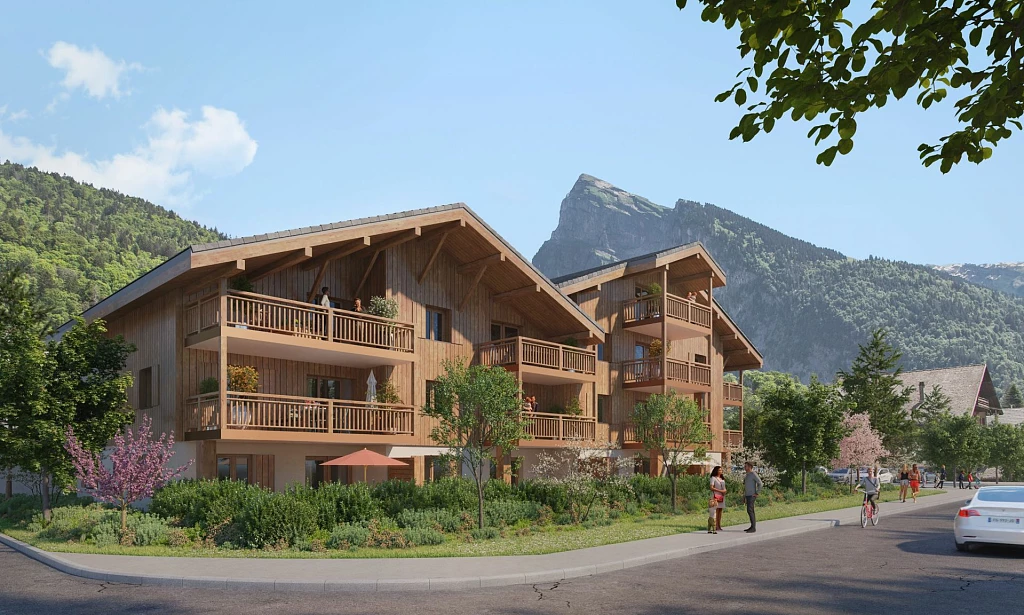
The data now suggests that arrangement was always provisional, not natural. Search interest in Samoëns for the summer months has climbed steadily since 2017, with the United Kingdom the largest single source of that demand, ahead of France itself, then Switzerland, the Netherlands and Germany.
The pattern holds on the ground: among the valley's short-term rental guests, the UK is already the largest international market after French visitors themselves. On Airbnb's own platform data for the year to July 2026, August now sits inside the same top seasonal bracket as January and February.
Across those three peak months, average occupancy runs at 54% and nightly rates hold near $267, whichever of the three a guest has chosen. September, not August, is the valley's quiet month now.
The reading from the ground matches the reading from the data. Athena Advisers has fielded more enquiries on Samoëns property this summer than on any other resort in its portfolio, an anecdotal signal, but a consistent one.
"Clients aren't just buying for value, they're buying for value that keeps appreciating," says Charlie Williams, Athena Advisers' head of partnerships and an Alpine property specialist.
"Geneva is an hour by car, the ski domain is large enough to reach real altitude, and the village doesn't close for eight months of the year. People use it the way a holiday home is meant to be used: they come and go as it suits them. On the otherhand, in some resorts the same money buys three weeks of skiing in January and an empty house for the rest of the year."
None of this makes Samoëns unusual among Alpine resorts chasing a second season. What makes it different is that it does not need to manufacture one.
The stonecutters' quarter that gives the old town its carved lintels and fountains, the botanical garden at Jaÿsinia, laid out in 1906 by Marie-Louise Cognacq-Jaÿ, founder of La Samaritaine, on land above the village where she was born: none of this was built to fill July.
Samoëns was granted its market charter by the House of Savoy in 1355 and its civic franchises in 1431. It was a functioning town, with a functioning summer, five centuries before anyone thought to hang a chairlift off the hillside.
The Wall on Three Sides
The harder constraint, and the more useful one for anyone weighing the next decade rather than the next season, sits a few kilometres up the valley. The Cirque du Fer-à-Cheval is the largest mountain cirque in the Alps, a limestone amphitheatre whose cliffs rise to 700 metres, protected as a site classé since 1925 and now the core of a 9,000-hectare national nature reserve.
It draws some 300,000 visitors a year, by the estimate of the Syndicat Mixte du Grand Site de Sixt-Fer-à-Cheval, the state-recognised body that manages the site, the great majority in the months the ski trade used to write off.
It also does something no marketing campaign can: it fixes, permanently, how far the valley is allowed to build. Samoëns is walled in on three sides by protected rock, the same rock the guides brought Sir Alfred Wills to see.
The neighbours have already been repriced for this; Samoëns has not. According to Adnov, a property in Les Gets, 20 minutes down the same valley road, now trades at roughly 37% more than the equivalent in Samoëns.
In Morzine the premium runs to about 55%. In Megève, both a longer drive and a longer-established name, it is more than double. None of the three has a cirque it cannot expand into.
Whatever demand does next, arriving in August or in January, supply has already had its final word.
We recently held a webinar where our Alpine property experts took a closer look at Samoëns, what made it the most sought-after Alpine destination this summer, the resort's market dtnamics and three of the best property opportunities. Watch the replay here.


