


You've described neoclouds as changing the criteria for data centre land, not just the market. What did the old criteria look like?
David: For years, the buyer was a hyperscaler, and the hyperscaler needed everything: hundreds of megawatts, a huge contiguous site, years of permitting runway. If your land didn't clear that bar, it wasn't part of the conversation. That's not a criticism of the model; it built the internet as we know it. But it meant a great deal of land with real potential sat outside the market entirely, simply because it wasn't big enough for that one type of buyer.
And the neocloud changes that how, exactly?
David: A neocloud doesn't build its own hardware. It sells access to GPU capacity, computing power for AI, as a service. Its customers need that capacity now, not in three years, so its own development cycle has to move faster and its footprint can be smaller. Gartner thinks neoclouds could take a fifth of the global AI cloud market by 2030, and that by 2029 half of all cloud capacity will be running AI workloads, against well under a tenth today. Whatever the precise numbers settle at, the direction is clear. That's a buyer who can work with thirty or fifty or eighty megawatts, not one hundred and fifty. A site that failed the old test can pass the new one.
Why is this happening now? Hyperscale demand hasn't gone away.
David: No, and it won't. Those campuses are still fundamental, and they'll keep getting built. But especially in Europe, the model is under real strain. Energy availability is tighter than it used to be, permitting has become more complex, and land that actually meets every requirement for a project that size is getting harder to find. None of that is a crisis for the hyperscale model. It's just friction, and friction is exactly the condition that lets a different kind of operator, with a different set of requirements, start to matter.
So the land itself hasn't changed. The measure has.
David: Exactly, and that's the part I find genuinely interesting. Location and grid access still matter, obviously. But now they sit alongside how quickly you can expand, how close you are to the right peering points, how fast a project can move through permitting. A piece in TEK Notícias put it well recently: the next phase of neocloud competition won't be won on GPU access alone. It will be won on connectivity, on network efficiency, on latency. That's a property argument as much as a technology one.
Is this a bigger story than AI, then?
David: I think so. It's tempting to read all of this as a technology story, GPUs and training runs and so on, but underneath it, it's a structural change in how digital infrastructure gets valued. For a long time, the market had one type of occupant, essentially, and everyone appraised land against that one profile. Now there's a second profile emerging alongside it, with different needs and often faster decision cycles, and that changes how you look at territory itself, not just how you look at AI.
Where does that leave a market like Portugal?
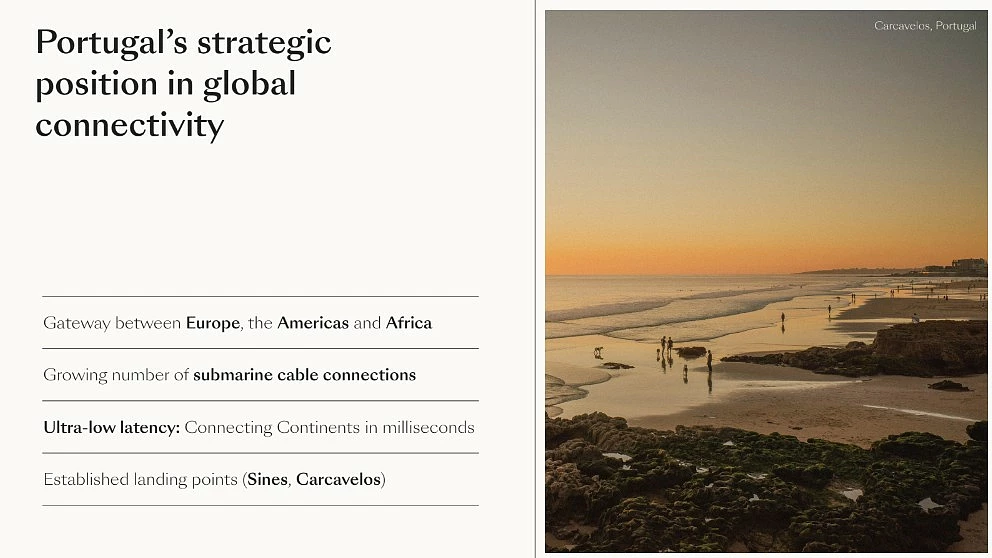
David: In a good position, and for reasons that have nothing to do with luck. The Atlantic coastline, the subsea cable landings, the improving interconnection: those were always there. What's new is that land which never had the scale for a hyperscale campus now has a credible buyer. I'd be careful not to overstate it. These remain complex, regulation-heavy, technically demanding projects, and not every hectare with a power line nearby is suddenly a data centre site. But the pool of land worth looking at has widened, and it widened without anyone lifting a shovel.
If you had to leave a reader with one thought about this?
David: That competitiveness, going forward, will depend less on how big a site is and more on the combination behind it: energy, connectivity, speed of execution. That's a more interesting way to assess land than square metres or megawatts alone. And the opportunities tend to go quietly to whoever identifies the right combination first, not to whoever waits for the market to confirm it. The most interesting opportunities are rarely the ones everyone is already measuring. They're the ones where the measuring stick just changed.


