


Across dozens of studies pooled in a 2022 meta-analysis in the Journal of Transport and Land Use, the property premium created by a new rail station peaks almost exactly five minutes from the platform, roughly 500 metres, before decaying sharply and vanishing beyond 1.6 kilometres. Santos, which will be welcoming a metro line in the first quarter of 2027, is small enough that this radius covers almost the whole neighbourhood rather than a single favoured street. The interesting question is not whether the premium arrives. It is what it is arriving on top of.
A design for life
Long before anyone in Lisbon drew a Circular Line on a map, Santos-o-Velho, Santos the Old in the literal Portuguese, had begun rewriting itself. The riverside quarter of aristocratic mansions had emptied out through the twentieth century as the workshops and small industry behind it closed, and into those vacated streets, in 1985, walked a design furniture shop called Paris:Sete. Domo followed in 1989, setting up at Largo de Santos with pieces from Minotti and Fornasetti. By 2005, enough showrooms and studios had gathered around them that a local entrepreneur, Gustavo Brito, gave the cluster a name, Santos Design District, and two schools, UAL and ETIC, now put thousands of students through the neighbourhood every year.
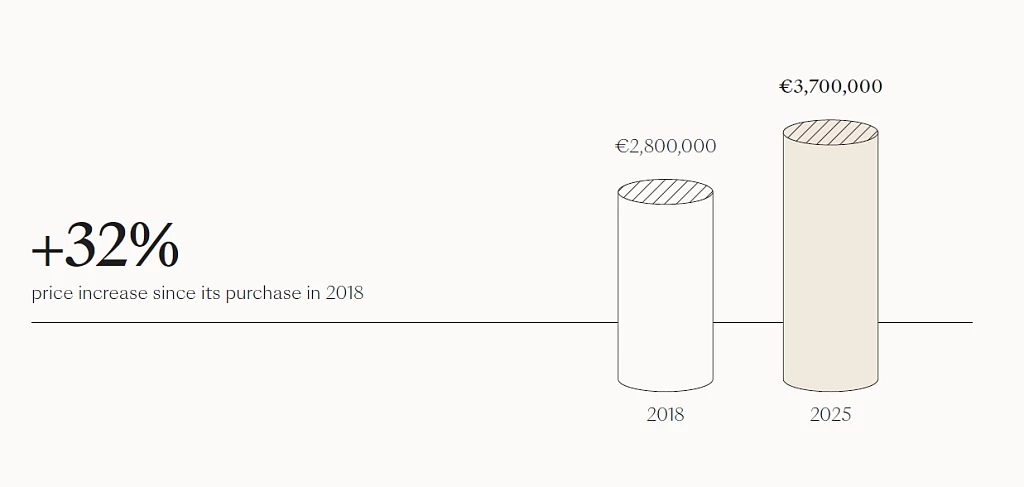
The renaissance, and the capital appreciation that comes with it, has not stopped. It is still working itself out, and we have seen it firsthand: property for sale in Santos is among the most sought-after in our portfolio, and we sold one property here in 2025 for €3.7 million, against a purchase price of €2.8 million in 2018, a gain of 32% achieved entirely before the station existed. None of that appreciation needed a metro. It needed a district that kept giving buyers reasons to want it.
Compound interest
The station will sit 25 metres below ground, beneath the Lisbon Firefighters Regiment's own headquarters, reached by a single pedestrian access point and three lifts, one at Chafariz da Esperança on Avenida Dom Carlos I, the other two on Travessa do Pasteleiro. The extension connecting Rato to Cais do Sodré through Santos and Estrela represents a €380 million commitment, nearly double the €210 million originally budgeted in 2018, a reflection of the engineering required to route tunnels beneath a historic riverside quarter without disturbing what sits above it. Metropolitano de Lisboa expects the finished line to carry nine million new passengers in its first year alone. It is a public commitment, not a promotional one, and it reads as much as confirmation as investment: the same conviction that drew Paris:Sete and Domo into Santos 40years ago has now reached the state, which is spending €380 million on the same bet. CBRE has estimated that the new stations on this line, Santos included, could lift nearby property values by 10 to 15%.
For anyone buying here now, the more useful number is the one Santos already delivered without a station: that 32%. A station that creates value from nothing is a timing bet: get in before the ribbon is cut, and hope the market agrees with you afterwards. A station that lands on a district already 40 years into reinventing itself is a different proposition entirely, since the appreciation does not depend on the infrastructure working as promised. It depends on Santos continuing to be Santos, which it has managed for four decades without anyone's help.
What changes now is not whether Santos rises; it already has, but who gets to say they bought before it rose twice. Properties acquired while the neighbourhood was still only a design district, and not yet a design district with its own metro stop, sit on two gains rather than one: the appreciation already banked, and whatever the five-minute walk adds on top of it. The same logic holds for buy-to-let investors. A neighbourhood that already drew renters for its workshops, its schools and its river view now offers them a direct line into the rest of the city as well, and an apartment with that combination tends not to sit empty for long.


