


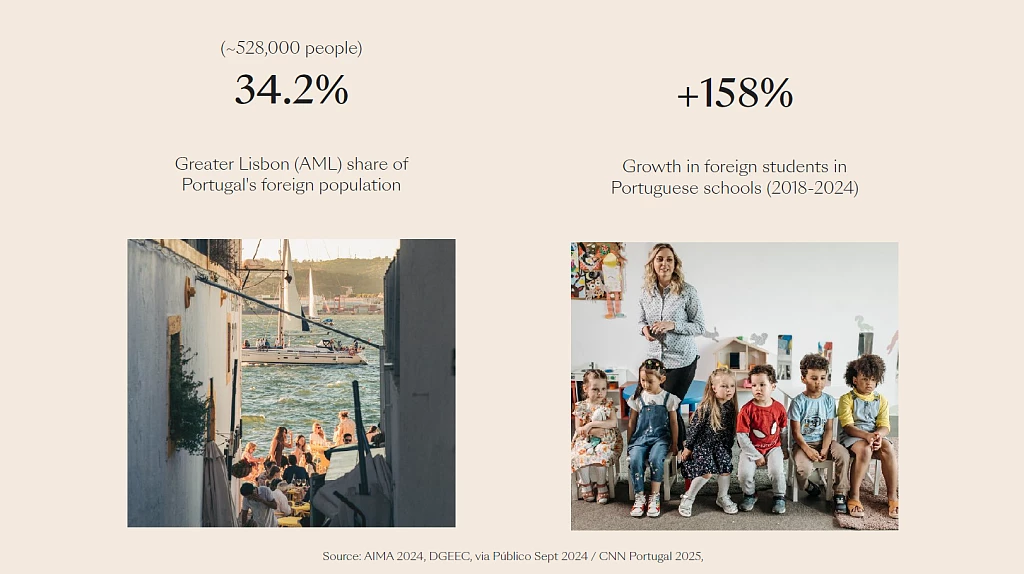
The numbers explain why. Nationally, the count of foreign pupils in Portuguese schools rose from roughly 53,000 in the 2018/19 academic year to 140,000 by 2023/24, a jump of more than 160% confirmed by Ministry of Education data, and it rose again the following year to 157,000. Portuguese classrooms now average pupils from nineteen different nationalities, nearly double the eleven recorded in 2018/19. Greater Lisbon, where more than three dozen international schools now operate, absorbs an outsized share of that growth, and supply has not kept pace. "There's so much demand, to be honest, that new schools have been popping up like mushrooms," says Carlota, founder of Mimosa Forest School in Cascais. "It's very hard to get an exact number of how many new schools, because they keep on showing up and they are always full even though they are new."
None of this is happening in a country short of reasons to attract families in the first place. Portugal held seventh place in the 2025 Global Peace Index, a ranking it has kept into 2026, ahead of every large European economy bar Switzerland and Austria. Safety, in other words, isn't the scarce resource. Classroom space is.
A market with no off-season
Conventional property markets have seasons: a quiet August, a busy spring. Lisbon's school admissions calendar has one window and one only. Applications open in February and March for a September start, and popular schools fill within weeks. Miss it, and the alternative isn't a lower tier of school, it's a waiting list, sometimes for a place a family won't use until January, at fees that start regardless. Carlota doesn't soften what happens to latecomers at a sought-after school: "Depends if it is a very popular school, probably not. They will say, 'Look, it's in September and this is when the year starts, and if you want, you can apply. You can start in September and only come in January, but you have to pay the fees starting in September.'"
The practical consequence is that the calendar, not the budget, sets the pace of relocation. Her advice to families weighing a move is blunt: register before the address exists. "Start looking at schools already. Start applying already. Even if you don't have your address, start asking the questions. Go visit the school. Put your name there, say: 'I'm here and I want to go.' Because the earlier, the better. And then you choose your address, and as soon as you have it, then you start the application."
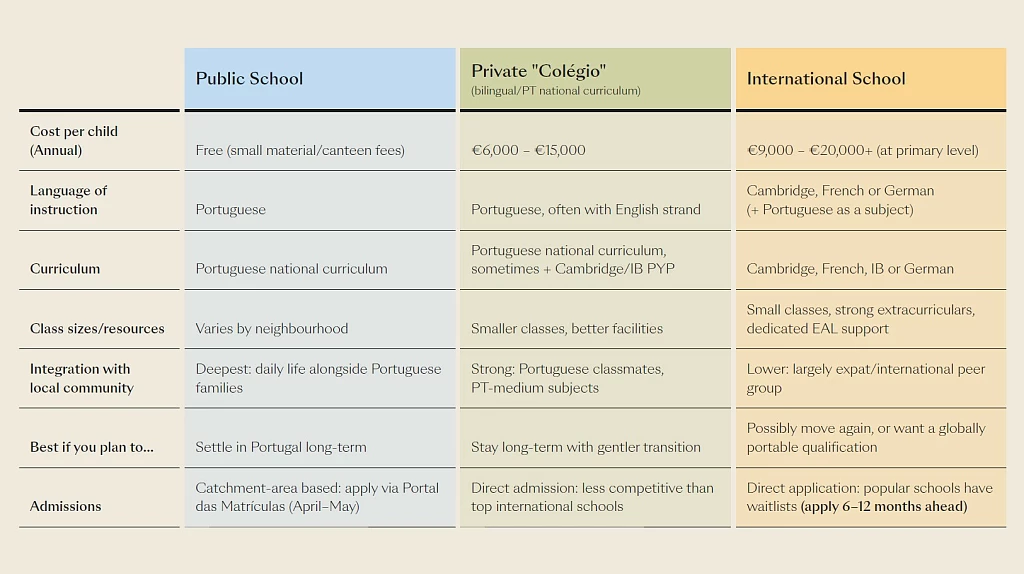
The choice of curriculum sharpens the timing pressure rather than easing it. A family weighing Red Bridge's English or French tracks, the Lycée Français's fully French system, or the IB route at St. Dominic's or Oeiras International isn't just picking a teaching philosophy. Cambridge, IB and the French baccalaureate travel; the Portuguese national curriculum, used in public schools and most private Portuguese ones, does not transfer as easily if a family later relocates or a child applies abroad. That decision, made under a February deadline, quietly sets the child's academic passport for the next decade.
The consequence shows up on the map. Estrela, Campo de Ourique and the stretch of Carcavelos around St. Julian's are no longer simply well-regarded addresses; they are, increasingly, the postcodes that sit within walking distance of a school with a waiting list. Almada, on the far side of the river and once a harder sell to Lisbon buyers, has gained ground for the same reason: an international school and a golf course now anchor a part of the city that used to be defined mainly by its view back across the water. None of these neighbourhoods were chosen just for their yield. They were chosen for what happens at 8am.
Where the address comes last
That reversal changes what a property search actually optimises for. Carlota is direct about what's really at stake in choosing where to live: "Please bear in mind the distance between properties and school, because the mornings are very important and they will change your day." She's equally direct about where that logic breaks down. On the idea of buying a property in Lisbon and commuting to school in Sintra, she said: "Honestly, for the sake of the children, living in Lisbon and going to Sintra, I don't wish that on anybody. Even though you're in the opposite sense of traffic, you won't have traffic, and if a 40-minute commute is okay for you, then you can do it. But you have very good options that are closer. So I wouldn't advise." Cascais to Lisbon, by contrast, works, and plenty of families and teachers make that trip daily. Sintra, in her words, "is a little bit too far."
 Secret Garden Villas, Campo de Ourique, Lisbon
The logic is unglamorous but precise. In a market where places don't reopen mid-year and demand keeps arriving faster than classrooms do, the family that secures both the school and the address early hasn't bought a house and enrolled a child as two separate transactions. It has bought itself a year nobody else in the queue will get.
If you'd like to learn more about schooling in Lisbon, we held a webinar on this topic in August 2026. Click here to watch the webinar replay.


