


There is a reliable sequence to urban value creation, and Lisbon is following it with unusual transparency. First comes the creative class, drawn by cheap space and good light. Then the restaurants, the galleries, the converted warehouses that become offices. Then, eventually, the infrastructure: the signal that the city itself has decided the neighbourhood is permanent. In Marvila, that signal arrived in the form of a tram.
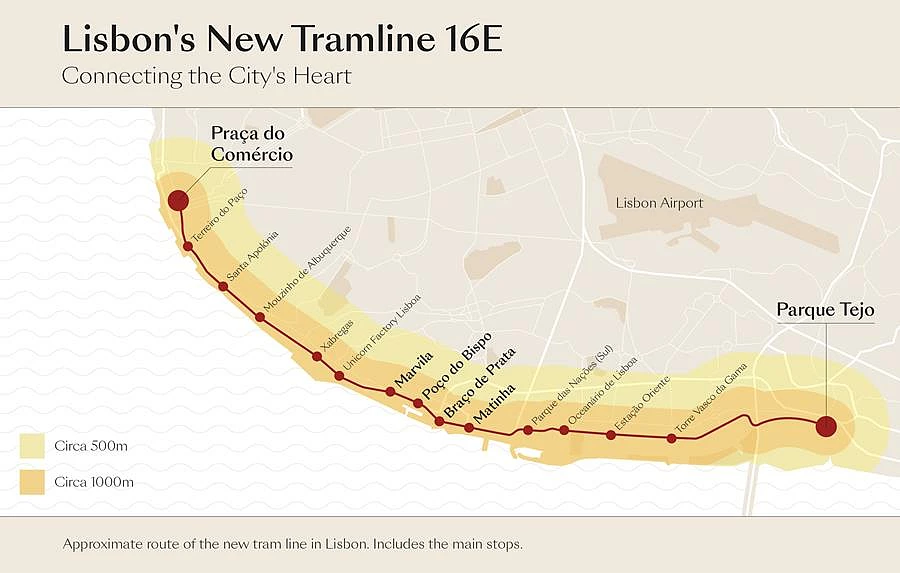
The 16E, announced by Carris in April 2025, will connect Praça do Comércio, the grand riverside square that has anchored Lisbon's centre for centuries, to Parque das Nações 12km east along the Tagus. The route runs directly through Marvila, with four dedicated stops serving the neighbourhood. The estimated investment is €160 million and completion is expected between 2027 and 2028. The line is projected to carry 8.1 million passengers annually, 18% of whom will be entirely new public transport users. It is, notably, the first expansion of Lisbon's tram network in over seventy years; not a routine infrastructure upgrade, but a statement of urban intent.
For anyone who has watched European cities regenerate over the past three decades, the pattern is familiar. New urban transport infrastructure does not follow value; it creates it. Across comparable European markets, properties within 500 metres of a new tram or metro stop have typically seen an appreciation of around 10% upon completion. Marvila is not a speculative bet on that thesis. It is a relatively late-stage confirmation of it.
The decade ahead
The neighbourhood has already absorbed ten years of transformation. Long dismissed as an industrial backwater on Lisbon's eastern fringe, Marvila has spent the past decade building an identity: converted warehouses repurposed as creative studios, independent restaurants occupying former factory floors, a demographic shift that has brought younger residents and international buyers to streets that had seen neither for a generation. According to Confidencial Imobiliário, Portugal's independent property transaction databank, the average sale price in Marvila reached €7,189 per square metre in the first quarter of 2025, an 8% rise year on year.
What the tramline does is resolve the one argument that has kept Marvila below its potential. The neighbourhood has character, scale and a development pipeline that most European cities would envy. What it has lacked is a direct, reliable link to the city centre. The 16E closes that gap, and for those exploring property for sale in Marvila, does so at a moment when the broader investment case has rarely been more legible. More than €3 billion in public and private investment is committed to Marvila over the coming decade, anchored by VIC Properties' €2 billion redevelopment of the former Matinha industrial site and supported by a wave of residential, commercial and public realm projects that together amount to something closer to urban reinvention than regeneration.
The longer logic
The comparisons being made in the market, Battersea and Seine-Saint-Denis, are not idle. These are neighbourhoods that were written off, then transformed by the combination of infrastructure commitment and sustained institutional investment, and which now trade at a significant premium to where they began. The mechanism is the same in each case: a credible public signal, followed by private capital, followed by the buyers who arrived early enough to benefit from the sequence rather than pay for it.
Marvila is not yet priced as a destination. That is precisely the point. For buyers operating on a ten-to fifteen-year horizon, acquiring for capital preservation, lifestyle optionality and the long-term logic of a city actively investing in its own future, the windows that infrastructure announcements open tend to close faster than most expect.
The tram is coming. The question is where you are when it arrives.