


Whilst the Côte d'Azur is now synonymous with sun, sand and exciting property investment opportunities, for the better part of a century, it was a winter destination. The grand hotels of Nice and Cannes ran a strict November-to-April season; come May, shutters closed, staff dispersed and British and Russian aristocrats decamped home. The very idea of summer on the Riviera - the thing that now defines it - would have struck a Belle Époque hotelier as quite absurd.
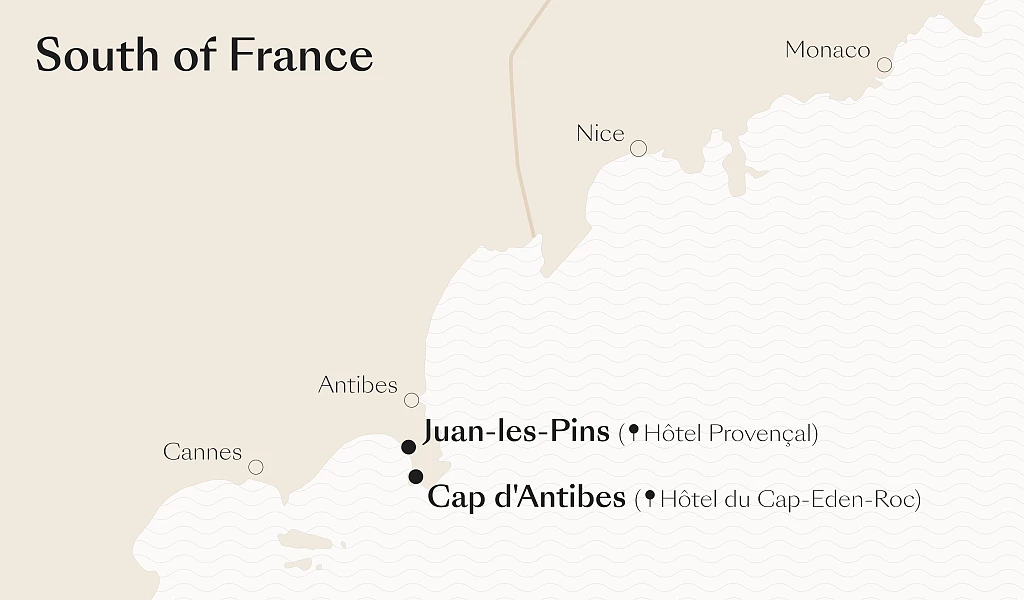
The story of how that changed has many authors - but its most vivid chapter is set in Juan-les-Pins, the pine-shaded bay tucked between Antibes town and the Cap d'Antibes peninsula.
The Murphys and the summer that broke the rule
We can pin the start of the Riviera summer we know today to the summer of 1923. That summer, a small American circle led by wealthy expats Gerald and Sara Murphy persuaded Antoine Sella, owner of the Hôtel du Cap on the tip of Cap d'Antibes, to keep one wing of the hotel open through July and August. Sella was sceptical but agreed. The shift had been gathering quietly - artists had been summering in Saint-Tropez since the turn of the century, and the First World War had already scrambled the old aristocratic rhythms of the coast - but it was the Murphys who gave it an address. From their nearby home in Cap d’Antibes, Villa America, they proceeded to host the most extraordinary cohort of guests in twentieth-century cultural history: F. Scott and Zelda Fitzgerald, Ernest Hemingway, Pablo Picasso, John Dos Passos, Cole Porter and Dorothy Parker.
What the Murphys created, almost incidentally, was a proof of concept. Summer on the Riviera could be lived. The Hôtel du Cap-Eden-Roc – the hotel's name after the addition of the Eden Roc swimming pavilion – became the unofficial salon of the lost generation. F. Scott Fitzgerald wrote Tender is the Night about a barely fictionalised version of it.
Frank Jay Gould and the first purpose-built summer resort
The Murphys' summer experiment was a private one. The infrastructure that turned it into a market came from another American. Frank Jay Gould, son of the New York railroad financier Jay Gould, began acquiring land in Juan-les-Pins in the early 1920s. Where Cap d'Antibes had a single grand hotel, Gould saw the case for an entire purpose-built summer town. He commissioned the Hôtel Provençal, which opened in 1927 as one of the largest hotels of its kind on the coast, and expanded the casino into the social anchor of the resort.
Gould understood something the older winter resorts had not. Summer guests wanted a different kind of architecture. They wanted shade, pine trees, sea-facing balconies, casinos that opened until dawn and a beach that was actually a beach rather than a pebbled afterthought. Juan-les-Pins delivered all of it. Within a few seasons, it was the most fashionable summer destination on the Mediterranean.
Jazz, and a cultural inheritance
The cultural identity that Gould and the Murphys established compounded across the rest of the twentieth century. In 1960, Juan-les-Pins launched what would become Europe's longest-running jazz festival, Jazz à Juan. The festival hosted some of the genre’s most iconic musicians such as Miles Davis, Ella Fitzgerald, Ray Charles and Nina Simone. The festival is still held every July under the same canopy of pines that drew the original summer crowd a hundred years ago. By the time Bardot, Belmondo and Sagan had taken their turn on the Pinède in the 1960s and 70s, the role was clear: this was where the Riviera came to summer.
The market this history built
A hundred years on, the property market on this five-kilometre stretch reflects the conditions that created it. Towns that are deliberately invented – built for a specific purpose, in a specific year, by people with a specific cultural vision – are unusually rare on the European coast. The original architectural inventory here was built between the 1880s and the 1940s, and protection of that fabric is now a matter of public policy. New development is rare, and tightly framed when it does happen. What this produces is a market with two distinct tiers. Cap d'Antibes itself sits consistently among the most expensive real estate in France, in the same conversation as Saint-Jean-Cap-Ferrat for prime villa values. The families behind many of the original estates have held them for three or four generations. Transactions on the peninsula are rare events, often privately negotiated and frequently never publicly listed. The Belle Époque estates along the cap's eastern flank, the villas that hosted the lost generation a century ago: none of them trade like ordinary real estate.
Juan-les-Pins itself is a different proposition. The inventory is more diverse and more accessible: the seafront apartments of the 1920s and 1930s along Boulevard Édouard Baudoin and Avenue Guy de Maupassant, the modernist additions of the post-war decades, and a small number of carefully sited contemporary developments. One of the most exciting is Beau Rivage, which occupies a coveted beachfront position in Juan-les-Pins and marries Art Deco charm and contemporary comfort.
Buyer demographics have broadened over the past twenty years, with American, Northern European and increasingly Middle Eastern families joining the long-established French and British presence. What the two markets share is the same underlying logic. Demand consistently outruns inventory, and the cultural identity that Frank Jay Gould and the Murphys created remains the most reliable driver of long-term value.
This is why we spend our time in places like this. Towns that get invented this carefully, and held this consistently do not happen often. They tend to reward the buyers who notice why.


