


There is a particular kind of buyer who has done Saint-Tropez. Not necessarily tired of it; the light off the gulf, the market on the Place des Lices, the specific quality of a Tuesday evening in July when the crowds have thinned slightly and the rosé is cold; but clear-eyed about what it has become as an asset. Prices on the peninsula have tracked so far ahead of comparable coastal markets that the calculus has shifted. Saint-Tropez retains its lustre. What it no longer guarantees is the logic to match it.
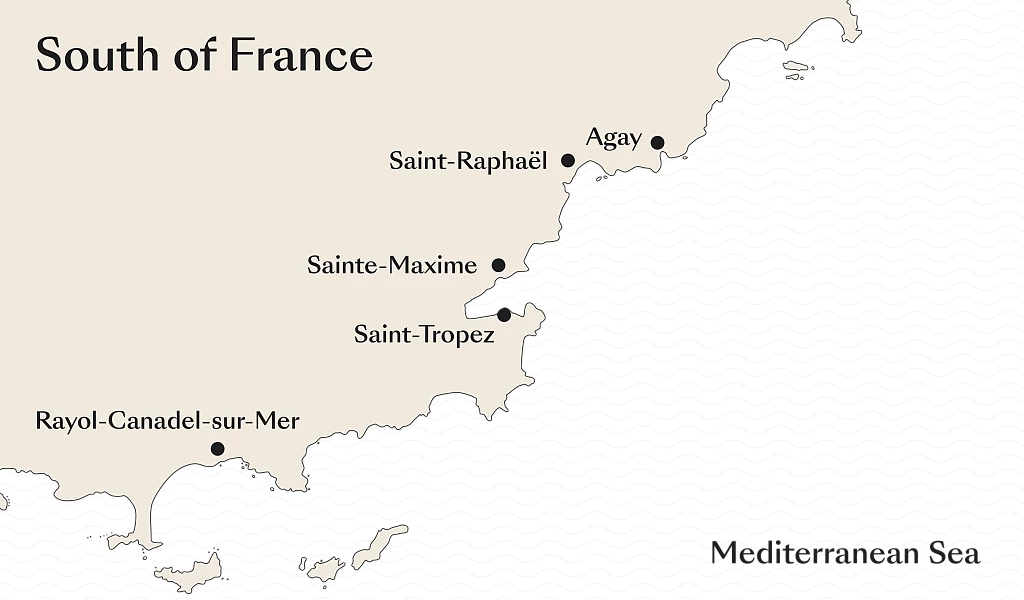
And that realisation is producing a detectable movement. Buyers who would previously have fixed their French Riviera property search on the Var peninsula are ranging wider, drawn by a new set of criteria: structural scarcity, protected natural environments, constrained development pipelines and the kind of quieter life that the Tropezien summer, for all its glamour, has made increasingly hard to find. What they are discovering is a stretch of coastline running roughly from Rayol-Canadel-sur-Mer in the west through Sainte-Maxime across the gulf, and east through Agay and Saint-Raphaël toward the Estérel massif, where those criteria are met with unusual consistency.
This is not a story about settling for less. It is a story about knowing where to look.
Rayol-Canadel-sur-Mer: scarcity by design
25km west of Saint-Tropez, Rayol-Canadel-sur-Mer is one of the most tightly constrained property markets on the French coast. The commune sits within a framework of protected natural land that effectively rules out meaningful new supply; what exists is largely what has always existed, and the planning apparatus is designed to keep it that way. In 2025 and 2026, the village ranked fifth among French communes of under 2,000 inhabitants for quality of life, according to the national ranking published by the Association des Villes et Villages de France.
New build prices for properties in Rayol-Canadel-sur-Mer run between €12,000 and €15,000 per square metre for premium stock, figures that reflect not luxury specification alone, but the structural impossibility of replication. When supply cannot grow, demand has only one direction to push prices.
Sainte-Maxime: the liquid alternative
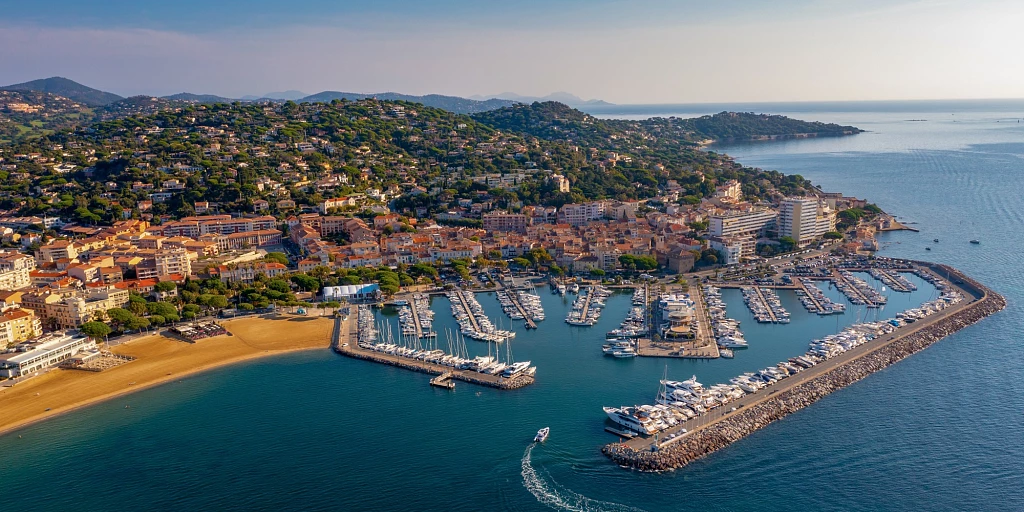
Directly opposite Saint-Tropez across the gulf, Sainte-Maxime has long been cast as the understudy in the peninsula's story. That is beginning to feel like a misreading. The town offers something its more famous neighbour increasingly struggles to guarantee: accessibility. Saint-Maxime has year-round road connections, maritime links across the gulf, plus proximity to two international airports. And beneath all of that, the residential property market is deep enough to allow genuine liquidity. The ability to buy, hold and exit on your own terms.
Premium new-build properties for sale in Sainte-Maxime range from €8,000 to €11,000 per square metre. For buyers weighing usage against patrimonial logic, this price gap relative to the peninsula is not a discount. It is a mispricing, and one that the market is actively correcting. Notaires de France data shows consistent appreciation across Var coastal communes over the past decade, underpinned by durable demand from northern European and international buyers. The window for acquiring ahead of that correction is narrowing.
Agay and Saint-Raphaël: the Estérel premium
Further east, where the Estérel massif drops its red porphyry cliffs to the sea, Agay operates on a different logic again. The topography is the planning constraint here: the natural park designation and the sheer drama of the landscape limit development as effectively as any regulatory framework. The result is a niche market of villas with panoramic sea views and a buyer profile oriented toward authenticity and long-term hold. New-build properties in Agay are priced between €6,500 and €8,500 per square metre, among the more accessible entry points on the Côte d'Azur for a genuinely scarce product.
Saint-Raphaël, broader and more urban, anchors the eastern end of this stretch just over an hour from Saint-Tropez. It is a town with genuine year-round life: a working waterfront, well-developed infrastructure, and a diverse range of properties spanning seafront apartments to character villas. New-build properties for sale in Saint-Raphaël sit between €7,500 and €10,000 per square metre. The investment case has sharpened recently and tangibly: Port Santa Lucia completed a €6 million modernisation programme in early 2025, and the wider Promenade des Bains project, a €65 million reimagining of four kilometres of coastline between Saint-Raphaël and Fréjus, is currently underway. This is public investment of a scale that tends to precede, rather than follow, price appreciation
The deeper logic
What connects these four markets is not geography alone. It is the same underlying condition that has always driven durable value on the European coast: the impossibility of replication. In each case, whether through planning protection, natural topography, or regulatory constraint, supply is structurally limited. What this produces, over time, is not merely a property market but a patrimonial one; assets held across generations, valued for their irreplaceability as much as their yield, and largely immune to the short-cycle thinking that governs less exceptional addresses. The buyers who are looking past Saint-Tropez are not retreating from ambition. They are applying a more precise version of it, one that weighs capital preservation, personal use and long-term coherence over the premium attached to a famous postcode. On a coastline where genuinely protected, irreplaceable addresses are rarer than they appear, that logic tends to age very well indeed.