


This week, Météo-France placed 54 of France's departments under a red heatwave alert: unprecedented, by the agency's own description. The Eiffel Tower restricted its hours. The Louvre closed early. Nearly 2,700 schools shut or rescheduled their days. Across the Channel, the Met Office has issued a rare red extreme heat warning for southern England, with national transport advising against all but essential travel and temperatures forecast to reach 39°C this week. Paris, London, Frankfurt and Brussels sit at the core of the heat dome, their urban centres turned into concrete ovens by a stagnant mass of Saharan air that has, for now, nowhere else to be.
On the terrace of a chalet in Châtel today, it is 23°C. Tomorrow in Val d'Isère it will be 16°C. Paris will reach 39. The title of this piece is not poetic licence. It is the arithmetic of altitude.
That gap is not a weather curiosity. It is a number that should interest anyone who holds, or is considering, European property.
The heat is on. The geographical Plan B is upwards.
The atmospheric lapse rate operates at roughly 6.5°C per 1,000 metres of elevation gain: a physical law, not a forecast. Châtel sits at 1,200 metres. Chamonix at 1,035. Val d’Isère at 1850. During summer, the Chamonix valley regularly sees temperatures of 25 to 30°C; higher up, the air cools further still. Late June through early September delivers consistently warm yet pleasant weather averaging 20 to 25°C at resort level. The difference between the city and the mountains is not approximate. It is guaranteed by atmospheric mechanics that no heat dome has ever overridden.
None of this would have surprised the Romans. When summer arrived in the city, the educated response was to leave it. Cicero maintained seven villas; Hadrian built an entire world at Tivoli, positioned in the hills east of Rome, specifically to catch the air. Roman families withdrew each summer to higher elevations where conditions were more comfortable: a pattern so consistent it became embedded in the architecture of power. What has changed is not the principle but the arithmetic. The cities they were escaping rarely exceeded 35°C. This week's lowland Europe is running considerably hotter, and the trend is not reversing.
This heatwave is the 52nd recorded in France since 1947, and two-thirds of those have occurred since the start of the 21st century. Météo-France has consistently warned that heatwaves are becoming more frequent, more intense, and starting earlier in the year. Each successive summer recalibrates what is tolerable at sea level. Each recalibration widens the gap between the mountain and the city below. The differential compounds. So does its value.
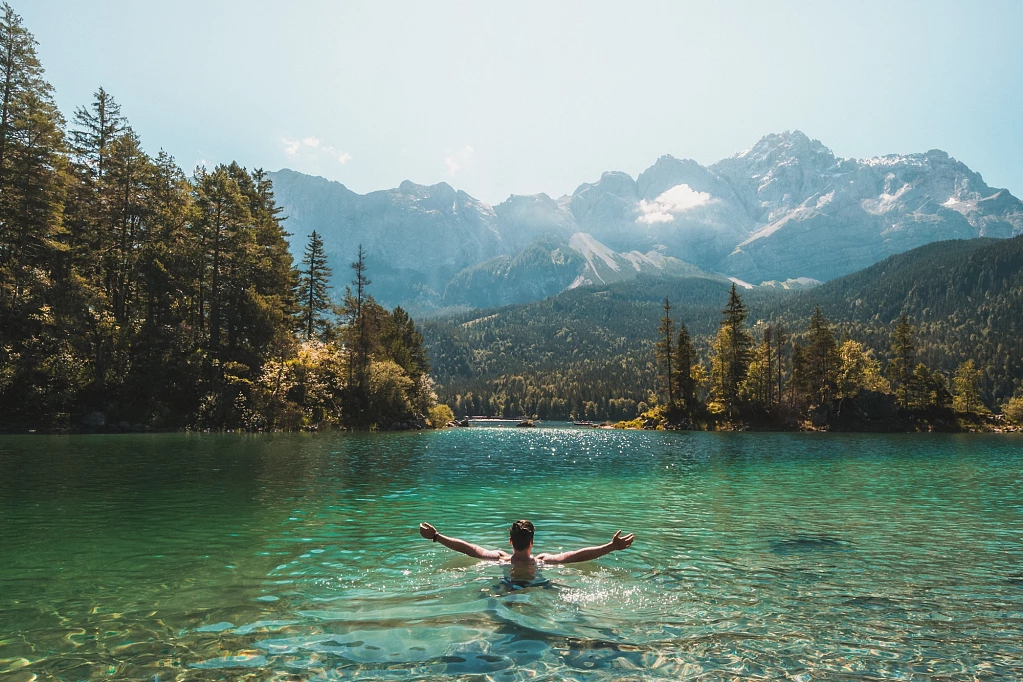
A cool escape
Alpine property has historically been assessed through the lens of the ski season: snow reliability, lift capacity, the calendar between December and April. That framework is being quietly superseded. The summer season, once the secondary consideration for high-altitude buyers, is becoming structurally longer, more distinct, and more valuable relative to the lowland alternative. We last took a look at this in our Summer in the French Alps report in 2025: a chalet above 1,500 metres, priced as a winter asset, is now delivering a year-round utility the market has not yet caught up with.
Formally, the French Alps were only really frequented by seasoned hikers and mountain bikers during the summer. However, that has changed considerably over the past decade. The mountains are rewriting their story as an accessible destination for all. From plunging into cool mountain lakes and summer skiing in Les Deux Alpes to white water rafting and via ferrata, they make for a refreshing break from city life.
The French Alps have also become a serious wellness destination. Yoga retreats run at altitude, spas have moved well beyond the après-ski rubric, and the fresh mountain air itself does work that no urban treatment menu can replicate. The mountains are not the backdrop to the offer. They are the offer.
Supply at a meaningful altitude is, by definition, fixed. Demand is being repriced by a climate that no policy intervention will reverse within any investment horizon that matters.
Waterfront property commanded its premium because proximity to water was scarce, unreplicable, and immune to development. Elevation is all three and, unlike a seafront, it comes with a physical guarantee written into the atmosphere itself.
The new waterfront is vertical.


