


Charlie Williams has been selling Alpine property for twenty years. He has watched the market absorb financial crises, a pandemic and a sustained period of rising interest rates without meaningfully correcting. Asked why, his answer is straightforward. "The French Alps is one of the few property markets in the world where the supply and demand argument is not a sales pitch," he says. "It is geography. Resorts are geographically limited. Developable land is highly limited. Planning policies are becoming increasingly restrictive. The dynamic is that supply remains finite whilst global demand continues to grow."
That dynamic has produced a market with one consistent direction of travel. According to Notaires de France, one in five buyers in Savoie and Haute-Savoie is a non-resident, a figure that has held steady across economic cycles and reflects the enduring pull of a region that offers something European buyers increasingly struggle to find: political stability, clean air, year-round liveability, and an asset class that has never seriously corrected.
What a million euros actually buys
The question Charlie and his colleague Charles-Antoine Sialelli, Head of French Alps Operations, are most often asked is deceptively simple: what does a million euros get you? The answer depends less on budget than on how well you understand the market.
"The most common compromise," Charlie explains, "is having to wait for the right property to be built, because the best units are sold off-plan before construction has even started." The French guarantee system, which protects buyers purchasing before completion, makes this a viable and well-established route. But it requires timing and decisiveness. In a market where supply is structurally constrained, the best properties in the best locations do not wait.
At the million-euro level, buyers should expect well-positioned apartments, duplexes, penthouses and occasionally semi-chalets. But the budget is only the starting point. Based in Annecy in the Alps, Charles-Antoine is on-the-ground carefully curating our property portfolio across the Alps and over his two decades at Athena Advisers he has identified six pillars that separates a property that separates a great property from a good one.
The six pillars
The first is resort positioning: international reputation, infrastructure quality and altitude. High-altitude resorts offer longer seasons, more reliable snow and stronger rental demand, factors that compound over time into meaningfully different resale trajectories.
The second is the exact location within the resort: the micro-neighbourhood, the exposure, the privacy. Two properties in the same resort at the same price can perform very differently depending on which side of the village they sit.
The third is views and sunlight: open aspects, natural light, multiple orientations. In the Alps, south-facing properties with unobstructed mountain views are not a luxury. They are a rental and resale premium that is remarkably consistent across markets.
The fourth is ski access: proximity to lifts and gondolas, closeness to the slopes, walkability. Ski-in/ski-out is the gold standard, but even a short, flat walk to the nearest gondola meaningfully outperforms a property that requires a bus or a car.
The fifth is village lifestyle: restaurants, shops, animation and events, year-round activity. The buyers arriving in the Alps today are not only skiers. They are families, remote workers, summer hikers and people building a long-term base in Europe. A resort that closes in April is a fundamentally different asset from one that functions across all four seasons.
The sixth is the asset itself: layout, number of bedrooms, outdoor spaces, architecture and finishes, and rental relevance. Energy efficiency has moved from a nice-to-have to a material factor in both rentability and resale value, particularly as French regulations around DPE ratings tighten.
The resorts worth understanding
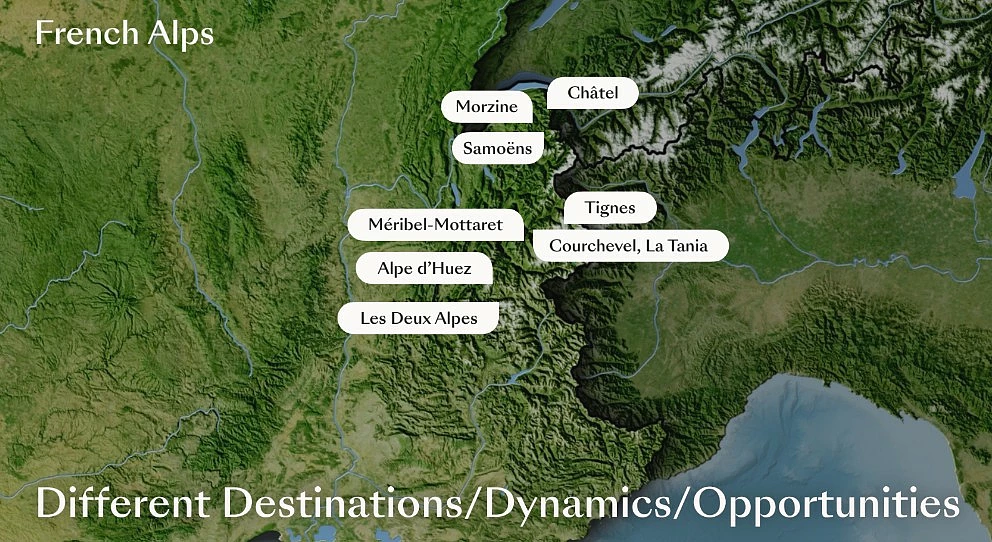
Within this framework, a handful of resorts consistently reward buyers who apply it carefully. Samoëns, in the Grand Massif, offers something increasingly rare: a genuinely authentic Alpine village with a year-round community, access to one of France's largest ski areas, and an hour's drive from Geneva. It is a resort that people fall in love with rather than settle for.
Morzine, anchoring the vast Portes du Soleil domain, brings international reputation and a dual-season offer that few resorts can match. Its summer credentials, mountain biking, hiking and an active village life, make it one of the most compelling year-round addresses in the northern Alps.
Châtel, prettier and more intimate, sits within the same domain but operates under tighter supply constraints. New social housing requirements have significantly limited new development. For existing owners and incoming buyers, this is not a complication but rather a structural protection of value.
Further south, Les Deux Alpes and Alpe d'Huez offer a different proposition entirely. High altitude, Les Deux Alpes reaches 3,600 metres with glacier skiing running well into late spring, combined with growing year-round appeal and price points that have not yet reached the levels of the more established northern resorts. For buyers seeking altitude and season length without paying the Three Valleys premium, this is where the calculation often lands.
Tignes deserves particular attention. With 22 weeks of skiable season, exceptional snow reliability, Michelin-starred dining and access to the Espace Killy, one of the largest and most celebrated ski areas in the world, it offers a combination of fundamentals that very few resorts anywhere can replicate. It is not a discovery. It is a market that rewards those who commit to it before the next wave of international attention arrives.
La Tania, car-free and family-oriented, and Méribel Motteret provide Three Valleys access at a price point that Méribel Centre and Courchevel have long since left behind, which is precisely its appeal for buyers who understand that domain access matters more than resort address.
The longer argument
What connects these resorts is not geography alone. It is the same condition that has made the French Alps a durable store of value across generations: the impossibility of meaningful new supply meeting growing global demand. Developable land is finite. Planning policy is tightening. Local governments are actively preserving resort character rather than permitting expansion. And the buyers arriving, from northern Europe, the Middle East, North America and increasingly Asia, are not slowing down.
A million euros in the French Alps is not what it was a decade ago. But it still buys, in the right resort and the right position within it, something that cannot be replicated and rarely disappoints over the long term. The six pillars are not a checklist. They are a way of reading a market that rewards those who understand it and consistently surprises those who do not.
Want to learn more? Charlie and Charles-Antoine hosted a webinar on this topic in June 2026. Click here to watch the replay.