


In June 1967, two tugboats manoeuvred a decommissioned 90-metre ocean liner through a 600-metre channel cut into the sand at Le Barcarès and left her there, three metres above sea level, for good. The ship, originally built in Copenhagen in 1931 and named Moonta for the South Australian coastal route she served, had since sailed the Mediterranean as the Lydia under Greek colours before being bought, stripped of her engines, and deliberately grounded as the centrepiece of a brand-new French resort. She is still there. The oldest grounded liner in the world, rusting quietly above a beach that bears her name, is the most honest symbol Le Barcarès could have: a thing that came from somewhere else entirely, stopped, and decided to belong.
The town itself followed the same logic. Before Mission Racine, the interministerial planning initiative launched under de Gaulle in 1963 to transform the Languedoc-Roussillon coast, Le Barcarès was a strip of sand between the Mediterranean and the Étang de Salses-Leucate, a 5,400-hectare Natura 2000 lagoon with more flamingos than residents. Senator Gaston Pams, who drove the initiative locally, did not build incrementally. He commissioned the canal districts, the marina, the residential quarters reclaimed from the lagoon edge, all at once; and placed a ship at the centre as proof of intent. Le Barcarès was not discovered. It was decided.
What the planners could not buy
What that deliberate act could not manufacture was the wind. The Tramontane arrives from the northwest, accelerating through the natural corridor between the Pyrenees and the Massif Central via a venturi effect, and descends onto the flat water of the lagoon with a force that coastal meteorologists at Météo France record on average one day in three across Languedoc-Roussillon. It blows in runs of three, six or nine days; locals have named the rhythm so long it has become proverb. It is cold, specific and irreplicable: you cannot move twenty kilometres down the Roussillon coast and find the same conditions. Windsurfers understood this before anyone else. The lagoon at Le Barcarès, with its shallow flat water and reliable wind, became one of the defining windsurf venues in Europe not because anyone planned it that way, but because the physics were simply correct.
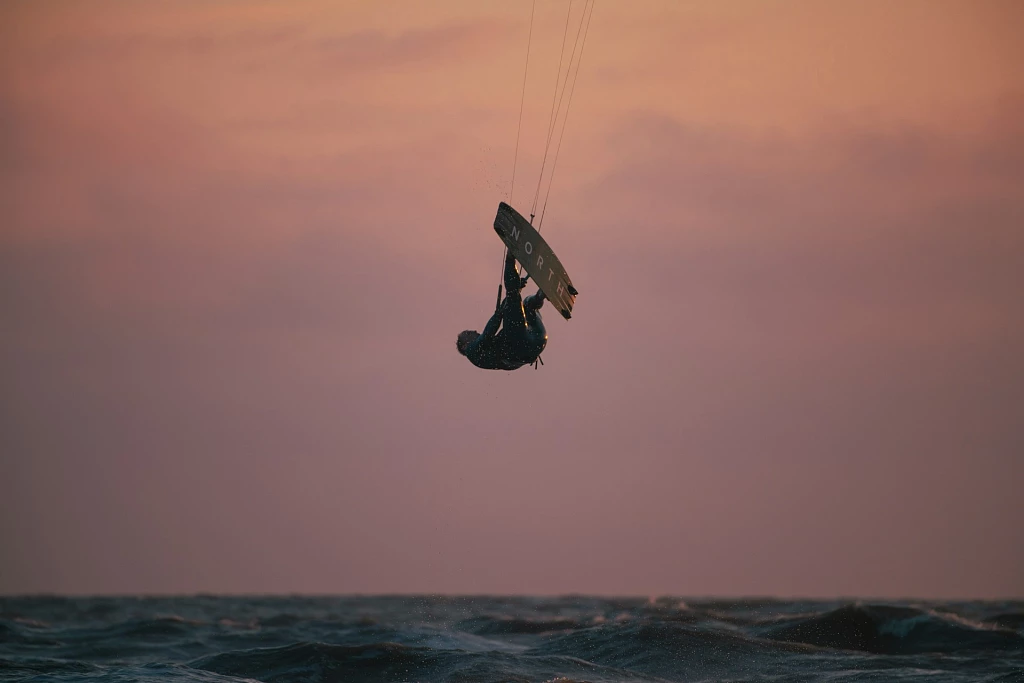
That sporting credibility has since compounded. In April 2025, the GKA Kite World Tour held the Lords of Tram Big Air World Cup at Le Barcarès, with 24 men and 12 women competing in winds gusting over 45 knots. The event placed the town in the same competitive geography as Tarifa and Cape Town. It also placed it on the map of a specific and consequential demographic: the international athlete and the well-travelled enthusiast who follows elite wind sport, stays in good properties, and notices when a place has not yet been priced for what it is.
The gap the market has not yet closed
That gap is currently significant. Prime Côte d'Azur property trades at up to €25,000 per square metre, with beachfront positions and sea views commanding premiums of 15-20% above that. Though the Mediterranean sunlight is the same and the water quality holds a Blue Flag rating, properties for sale in Le Barcarès are significantly more attractive. In comparison, an extremely rare beachfront apartment in the new-build La Vida Lydia project sits between €5,000 and €7,500 per square metre. What’s more, the constraint on future supply is, if anything, tighter in the area: the Chambre des Notaires des Pyrénées-Orientales reported in 2025 that new-build apartment sales across the département had stagnated at 300 units, with notaires citing the ZAN zero-artificialisation framework and mayoral reluctance to grant permits as structural constraints on pipeline supply. Within a Natura 2000 protected zone, any approved development must first clear the EU Habitats Directive's rigorous environmental assessment process. The projects that pass that filter are, by definition, few; and the surrounding environment, the lagoon, the pine forests, the biodiversity that makes the address what it is, remains legally protected from the kind of densification that eroded comparable coastlines elsewhere in France decades ago.
The Lydia sits at the end of the Allée des Arts, a beach promenade where contemporary sculpture shares the sand with open-air markets three mornings a week throughout the year. In winter, when the summer population of 90,000 contracts back to the 6,000 year-round Barcarésiens, the windsurfers are still on the lagoon. The fish stall at the market opens every morning, regardless of the season. The light over the Canigou, the Catalan peak visible from the shore on clear days, is best in October.
Most coastal towns make their case in summer. Le Barcarès makes it in the shoulder months, when the wind picks up, the crowds thin, and the lagoon returns to the people who actually know how to use it. The Lydia got here first and the buyers are catching up.


