


For most of the last century, the surest way to describe a valuable piece of French property was to say how far it stood from the sea. The answer came in metres, and buyers on Cap d'Antibes and the Île de Ré paid by the metre accordingly. In the French Alps, the equivalent measurement now runs vertically, and it has begun to set prices in much the same way.
The ski industry supplied its own evidence this autumn. France sold 56.1 million skier days last winter, overtaking Austria and the United States for the first time in eleven years, during what was also the fourth mildest winter on record. A warm year produced a record season because the season was settled high up. Les Deux Alpes, whose glacier reaches 3,600 metres, had its best winter for the fifth year running, and in Val d'Isère, Emerald Stay reports that more than two in five of this winter's stays were booked over three months ahead.
Parliament, oddly, saw this coming. In January 1985 it passed the loi Montagne, and within a year the loi Littoral. The two laws read almost like siblings, each confining new building to the edges of existing villages, and together they amounted to a quiet admission that France had a fixed supply of shoreline and a fixed supply of summit.
The market believed the first half at once: Saint-Jean-Cap-Ferrat, Ramatuelle and Saint-Tropez still lead the national ranking of communes by transaction price. Believing the second half has taken 40 years. In Habity’s ranking of French communes by average price per square metre, based on DVF transaction data, Val d’Isère and Courchevel stand fourth and fifth. Les Allues, the commune that contains Méribel, ranks eighth, five places above Paris.
The view from the Col de Porte
Météo-France has measured snow at the Col de Porte, 1,325 metres up in the Chartreuse above Grenoble, since 1960. Its record is undramatic, which is precisely why it persuades. The snow season there has shortened by about five days a decade, while above 1,800 metres the same series shows no meaningful change. The snow keeps falling; lower down, more of it simply arrives as rain. Plan, as the French state now does, for a country 2.7°C warmer, and the 1,800-metre band of the Northern Alps loses roughly a month of natural cover. The snow line behaves much like a coastline, except that its tide only goes out.
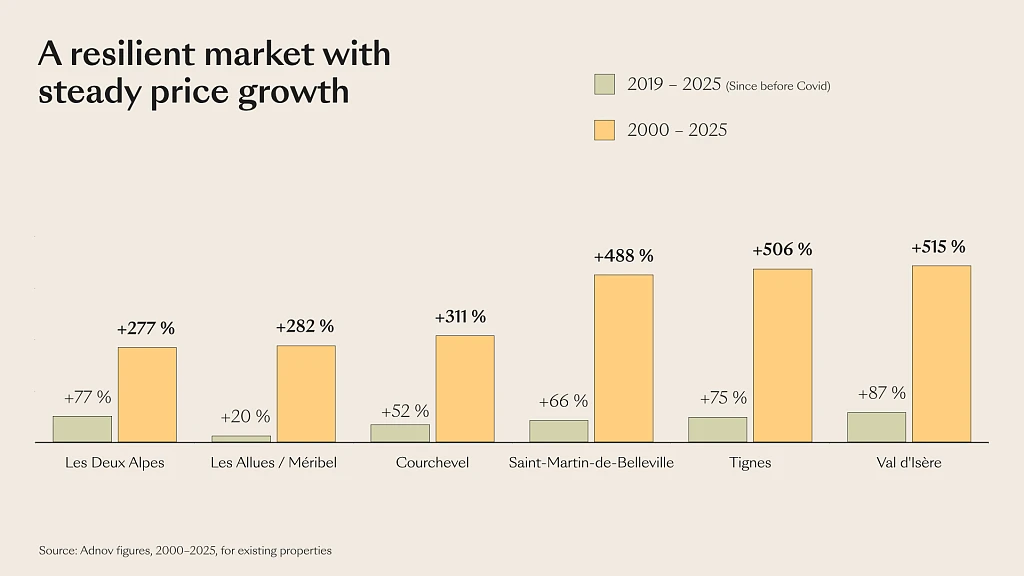
Prices have traced the same contour. According to notarial data from Adnov, resale prices in Les Deux Alpes, Tignes and Val d’Isère, whose lifts climb above 3,400 metres, have risen by an average of 80% since 2019. Across the Three Valleys resorts of Saint-Martin-de-Belleville, Méribel and Courchevel, the average rise over the same period was 46%.
Holiday tenants, who owe the mountain nothing and choose again every winter, are saying the same thing with their deposits. Emerald Stay, our longstanding rental partner in the French Alps, reports Courchevel rents up 11.9% in 2024 and a further 6.5% in 2025, Méribel's up 11.2% last year, and nightly rates for the better apartments in Val d'Isère up 11.8%. People do not pay more, and earlier, for snow they doubt.
For an owner, altitude is finally counted in letting weeks rather than metres. Tignes expects more than 20 weeks of skiing a year, from late November into the spring, and its lake and golf course bring a lively summer season. A longer calendar does not simply raise the yield; it spreads it, which is what makes an apartment behave less like a holiday and more like an asset.
Altitude, though, does not create scarcity on its own. That requires land, and some villages simply have none to spare. Val d'Isère sits on a valley floor bounded by avalanche corridors and protected terrain, and its buildings cannot spread beyond the footprint they already occupy. A new development there usually means an old one has come down. Parliament decided where the village could grow; the mountain decided it could not grow much. Adnov reports that resale prices in the commune have risen 515% since 2000.
This shapes what a buyer can actually acquire. In a village that cannot grow, new stock is replacement stock, and it arrives with advantages the older apartments it displaces cannot offer. Notary fees on new-build run at 2 to 2.5% rather than the 7 to 8% charged on resale, VAT can be recovered where the property is let with hotel-style services, and the 2024 loi Le Meur now ties the right to let a furnished holiday apartment to its energy rating. Much of the older stock at altitude will need renovating to keep earning. The newest has simply been built to the rules it will be judged by.
A different kind of altitude
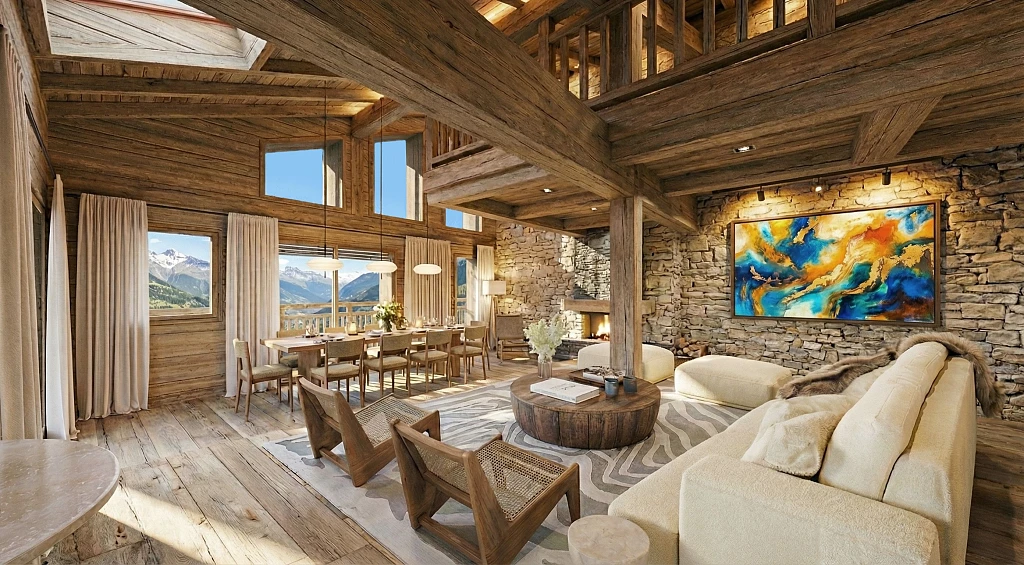
4-bedroom semi-chalet for sale in Megève
Megève ought to spoil the argument. The village sits at 1,113 metres, almost 700 metres below the line that matters to everyone else, yet it ranks above both Chamonix and Paris on the national property price table. The explanation is a century old. In 1921, Noémie de Rothschild opened the Mont d'Arbois, by most accounts to give her circle a French alternative to St Moritz, and Megève has been a place people live in, rather than merely ski from, ever since. It has three Michelin-starred tables, more than 200 shops and a social season that has never waited for snow. Six in ten buyers there are French, and a village with a year-round life tends to have a year-round rental market to match.
The coast taught French buyers that the most valuable land is the land no one can make more of. The mountains add a footnote. Altitude is scarce. A place people have never wanted to leave is scarcer still.


