


For as long as anyone in the property trade can remember, a chalet's summer was its off-season: the months when shutters stayed closed, the caretaker mowed the lawn, and the asset simply waited for winter to start earning again.
That assumption is now out of date. Across the French Alps last summer, overnight stays in mountain accommodation rose 2.5% to 44.6 million, according to INSEE. Since the pandemic, the mountains' pull on French buyers has not softened, and the reason has less to do with skiing than with what happens the rest of the year: remote work untethering people from the coast in summer, and a growing appetite for space, cool air and the outdoors precisely when the lowlands are at their most crowded and their hottest as explored in our “20 degrees of separation” article.
This shift in demand for a summer refuge in the mountains is perhaps most pronounced in Châtel in the Portes du Soleil. Here, average summer occupancy there climbed from 45% to 61% in two seasons, a sixteen-point move too large to be explained by good weather alone.
Laurent Lacourt, co-founder and chief executive of Emerald Stay, our long-standing rental management partner, draws a sharper line between the two Alpine models now emerging. High-altitude resorts such as Val d'Isère and Courchevel, he notes, remain anchored to winter, their nightly rates holding at some of the highest levels in the range. Mid-altitude villages, such as Morzine and Châtel, by contrast, are undergoing what he describes as a genuine shift toward year-round profitability, with summer no longer a rounding error on the annual return but a season carrying its own weight. It is a useful distinction: this is not every Alpine resort discovering summer at once. It is a specific tier of village, previously dependent on four good months, quietly building a second income stream out of the other eight.
Not every resort is cashing in equally
Morzine and Châtel are where the capital behind that shift is easiest to see. Morzine, 1,000 metres up in the Vallée d'Aulps and 40 minutes from Geneva, sits within the 280-piste Portes du Soleil domain; Châtel, on the Swiss border, shares the same lift network and now counts two Michelin-listed restaurants among its thirty-odd tables. Both are the subject of long-horizon public capital: Morzine's municipality has committed €115m through 2030 to a new town-centre gondola, an expanded bike park and a reinforced lift link to Avoriaz, investment explicitly aimed at year-round mobility rather than snow days alone. Châtel's growth, meanwhile, is being shaped less by new lifts than by restraint: its local urbanism plan is deliberately structured to preserve the village's architecture and keep new supply scarce. Hotel occupancy in both villages now runs 80 to 95% in high season, a range that increasingly holds in July as well as January.
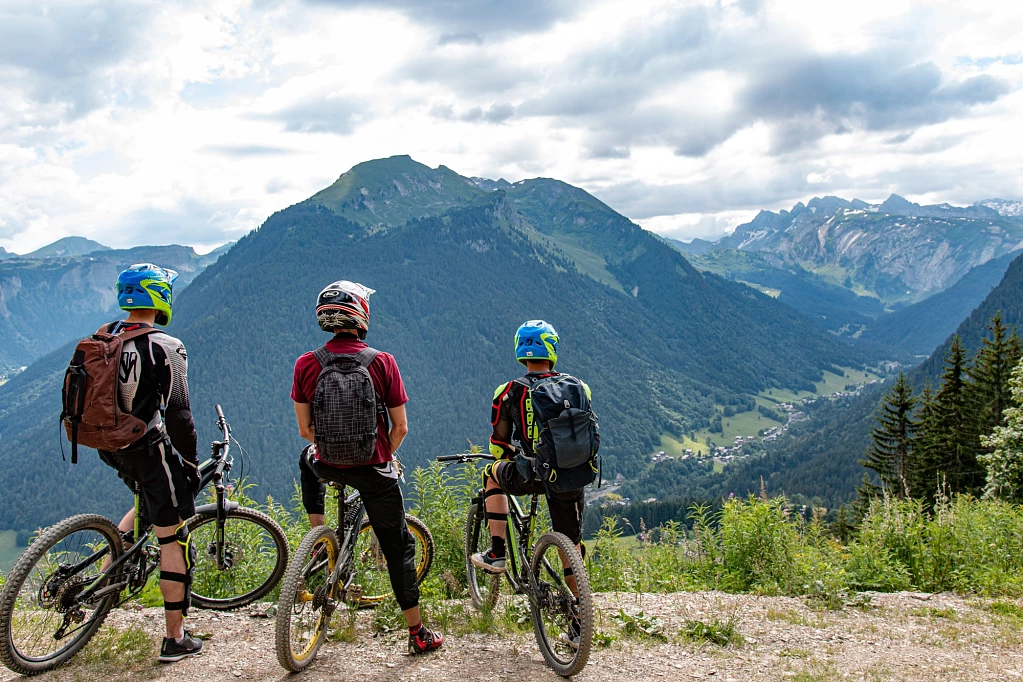
Châtel's own programming makes the shift concrete rather than aspirational. Its bike park now runs nineteen distinct descents, one of five that together form the Portes du Soleil's cross-border mountain-biking network, and includes a signature run laid out by the professional freerider Nico Vink. In June 2026, the village opened a new cultural centre, a wager that summer visitors want more than trail access, and the tourist office now runs a summer calendar of guided walks along the old smugglers' routes into Switzerland alongside cheese-cellar visits to local Abondance producers. None of this reads as programming bolted onto a ski resort to fill dead months. It is a village building a second identity on purpose, backing it with infrastructure, culture and heritage rather than activities alone.
None of this displaces winter as the dominant season; INSEE reports that the Alps still recorded 18.4 million winter nights in 2025, close to three-quarters of all French mountain tourism, and Val d'Isère is not about to reinvent itself as a summer resort. Tellingly, even France's highest, most snow-secure addresses are hedging the same way: Les Deux Alpes, built on a 500cm-a-year glacier and a cable car to 3,600 metres, is currently investing in year-round sports facilities and public space, explicitly to become what the resort calls a genuine lieu de vie rather than a ski-season outpost. If a glacier resort feels the need to diversify, the case for it in a mid-altitude village is not really in question.
The pricing reflects the shift, if not yet dramatically. Morzine has compounded at roughly 6% annually since 2000 while Châtel's average selling has grown by around 4% a year over the same period, both built substantially on a single ski season. The more recent numbers move faster: Morzine rose 5.9% and Châtel 6.6% between 2023 and 2025 alone, according to Notaires and ADNOV data, an acceleration that lands squarely in the same window as the four-season pivot these villages are now investing in.
The old ski chalet was a single-purpose asset with a long off-season. What is being built and bought in Morzine and Châtel now looks more like a hotel with a garden: two seasons, one roof, and a balance sheet that, for the first time, barely goes quiet.


