


Méribel's building code has nothing to do with the rental market and everything to do with it. When construction resumed after the war in 1946, the resort's founder, a Scottish colonel named Peter Lindsay, worked with the architect Christian Durupt to lay down a rule that has barely changed since: every building in wood, stone and slate, no concrete, no towers. It is close to eighty years old, and it is the reason Méribel has never seen the addition of high-rise developments like several of its Alpine neighbours in the 1960s and 70s. Quality control was never a response to a maturing market here. It was the founding principle. What is happening now, in the rental market rather than the planning office, is the same discipline finding a new target.
There was a period, not so long ago, when almost any apartment in the Three Valleys rented itself. The post-Covid surge in mountain demand was indiscriminate: a bed a few minutes from a lift found a booking regardless of what state it was in or who was running it. That period is over. Local operators now describe a healthier, more selective market, one where rates are settling into a genuine adjustment rather than a decline.
Stars matter, but not in the way you’re thinking
That shift now has the backing of French tax law, not just anecdote. Under the loi Le Meur, which took effect in January 2025, every furnished tourist let must be formally registered, and the fiscal treatment of a property now depends on whether it holds an official star classification: a classified, professionally run Alpine rental property keeps a far more generous tax abatement than an unclassified one. The state has, in effect, drawn the same line the market was already drawing: between a property that is merely available and one that is properly run and formally recognised as such. Our long-standing rental management partner, Emerald Stay, reports apartments under professional management commanding an average daily rate some 36% above the wider market average, a gap that owes far more to upkeep and service than to square footage.
 La Tarentaise, Méribel: new-build apartments with concierge, pool & wellness facilities
That distinction is showing up at the level of individual bookings, not just averages. Well-positioned Méribel apartments with genuine views, careful upkeep and a strong service layer are holding their rental value and concentrating demand toward themselves. Less differentiated stock, the kind that coasted through the boom years on scarcity alone, is the part of the market now absorbing the adjustment. Smaller and mid-sized apartments, in particular, are proving the most resilient combination of yield and stability, precisely because they are the segment where professional management makes the most visible difference to a guest's experience.
With seasons, size matters
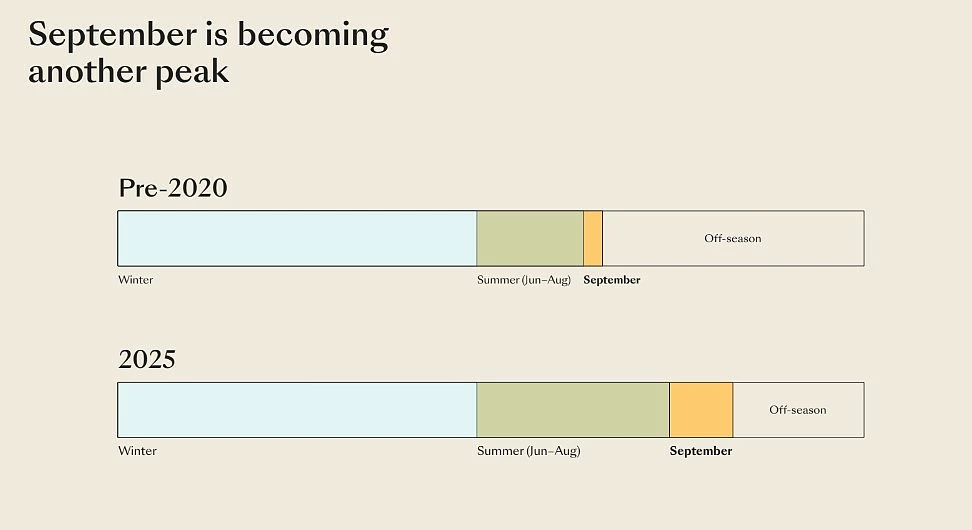
The same selectivity is starting to reshape the calendar itself, not just the market within it. September in Méribel no longer behaves like an afterthought tacked onto summer; year on year, it has been quietly widening into its own working period, eating into what used to be several weeks of genuine off-season shutdown. The shift is easy to miss because it happens at the edges rather than in the headline winter numbers, but it changes the arithmetic for any property built to be shown, not just occupied.
A well-designed, well-presented apartment is the one equipped to capture that extra month. Guests booking in September are choosing a place on its own merits, on light, layout and finish, in a way a January booking, driven by proximity to a lift, rarely requires. That is a different kind of scrutiny, and it rewards a different kind of property: one presented with the same care in its photographs and its upkeep as a hotel room, rather than one that simply exists and waits for the snow. Summer, and the September that now extends it, has stopped being a cursory touristic add-on to the ski business. It has become a second, smaller season with its own standards, and its own premium for the properties that meet them.
None of this is unique to Méribel; it is a preview of where the wider Alpine rental market is heading, and where French regulation is now pushing it. A first-time visitor chooses a village. A repeat one, increasingly, chooses an operator, and the law is starting to reward the operators worth choosing.
For a buyer, the implication is a quiet but important one. The postcode still matters, Méribel is not becoming interchangeable with a lesser-known village further down the valley, but it has stopped being sufficient on its own. Peter Lindsay policed the building. The market is now policing what happens inside it, and it is a good deal less forgiving than the planning office ever was.


