


Chaque grande ville possède son équivalent : un quartier suffisamment proche pour avoir de l'importance, mais dont les prix laissent penser qu'il appartient à un tout autre monde. Paris en a eu. Londres en a encore, par endroits. Celui de Lisbonne se trouve juste de l'autre côté du fleuve, et il ne se cache devant personne.
Une côte, trois niveaux de prix
La Costa da Caparica se trouve à 17 kilomètres du centre de Lisbonne, ce qui, selon l'heure, correspond à une traversée de 20 à 30 minutes sur le pont du 25 avril. C'est plus court que le trajet entre Chelsea et Canary Wharf.
Il est à noter que le péage n'est perçu que dans le sens nord, vers la ville ; en direction du sud, vers Caparica, la traversée du Tage est entièrement gratuite. Même la tarification du pont lui-même part du principe que la circulation est à sens unique. Le marché immobilier de Caparica a fait une hypothèse similaire, et celle-ci commence à paraître tout aussi dépassée.
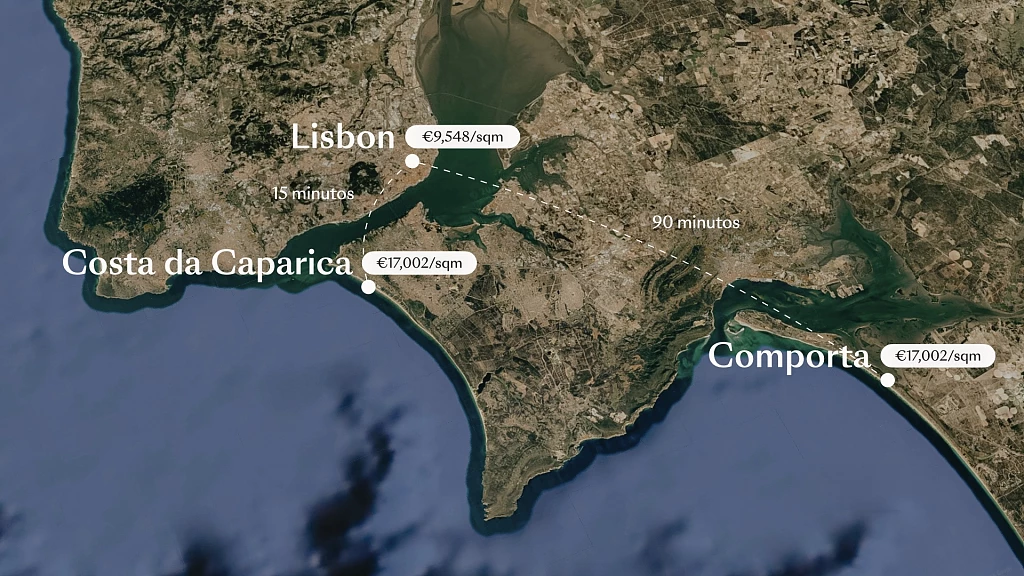
Le prix moyen au m² de notre parc immobilier à Caparica s'élève actuellement à 5 956 €. L'immobilier à Lisbonne affiche une moyenne plus élevée, à 9 548 € le m² : soit une prime de 60 % pour un emplacement situé à vingt minutes de traversée en dehors des heures de pointe, et à trente minutes aux heures de pointe.
Comporta, référence incontournable du luxe « pieds nus » au Portugal, affiche un prix de 17 002 € le mètre carré ; ses 60 kilomètres de littoral protégé et préservé justifient un prix qui repose autant sur la rareté que sur le prestige. Les 30 kilomètres de sable atlantique de Caparica sont rarement décrits de la même manière, et ne cherchent d'ailleurs pas vraiment à rivaliser avec eux.
L'offre proposée est différente : une véritable plage, à vingt minutes d'une capitale, pour des acheteurs prêts à troquer une partie de cette ambiance plus sauvage et isolée contre un trajet plus court et un littoral qui fait encore office de banlieue.
Combler l'écart de prix
Cet écart ne tient que si le marché continue de considérer Caparica comme une destination saisonnière : un endroit où l'on se rend en juillet, et non où l'on vit en février. Cette hypothèse a une durée de vie limitée, et les démarches administratives qui la sous-tendent sont plus avancées que ne le pensent la plupart des acheteurs.
En juillet 2024, la municipalité d'Almada, Metro de Lisboa et Transportes Metropolitanos de Lisboa ont signé un protocole officiel visant à prolonger le métro Sul do Tejo jusqu'à Caparica : sept kilomètres, dix nouvelles stations, traversant les quartiers résidentiels de la ville jusqu'à un nouveau pôle d'échange central.
Ce projet bénéficie d'un statut prioritaire de la part de l'État portugais et est financé par les fonds européens de cohésion et d'action pour le climat dans le cadre du programme « Portugal 2030 », et non par le budget discrétionnaire d'Almada. Les études préliminaires sont financées jusqu'en 2026 ; selon les prévisions de la municipalité, l'exploitation devrait débuter avant 2030.
Un lieu reste une banlieue perdue tant que les infrastructures correspondent à cette description. Ici, trois institutions publiques, en présence d'un ministre du gouvernement venu en témoigner, ont apporté leur soutien – ainsi qu'une ligne de financement européenne – pour s'opposer à cette situation.
L'argument des infrastructures explique pourquoi le prix pourrait évoluer. Il n'explique pas pourquoi le prix devrait se stabiliser une fois qu'il aura évolué, et c'est là la question la plus intéressante.
Une partie importante du littoral de Caparica se trouve au sein de la « Paisagem Protegida da Arriba Fóssil da Costa da Caparica », un paysage protégé désigné par décret-loi en 1984 et renforcé par une résolution gouvernementale en 2008. Les nouvelles constructions le long de ce front de mer ne sont pas limitées par le cycle du marché ou les tendances en matière d'urbanisme ; elles sont limitées par la loi.
Lisbonne a déjà mené une version de cette expérience par le passé. Le Parque das Nações était un site industriel à l'abandon jusqu'à l'Expo '98 ; environ 1,8 milliard d'euros investis dans les infrastructures publiques, dont le pont Vasco da Gama, l'ont transformé en l'une des adresses les plus chères de la ville. Le mécanisme était le même : engagement public d'abord, reconnaissance des prix ensuite.
La différence à Caparica, c'est que cette reconnaissance n'est pas encore pleinement acquise, et que le littoral auquel elle s'appliquerait ne pourra pas être reproduit plus loin sur la côte une fois qu'elle le sera.
 Villas de 4 chambres, Caparica Hills, Costa da Caparica
Il ne s'agit en rien d'une prévision. Cela revient plutôt à constater que le mécanisme de réévaluation des prix, que la plupart des acheteurs associent déjà à Comporta – une reconnaissance culturelle qui survient bien avant que les chiffres ne suivent –, est un phénomène que ce Journal a déjà observé à Caparica, sous un angle tout à fait différent.
Ce qui a changé depuis est plus prosaïque et, pour cette raison, plus convaincant : un trajet domicile-travail que personne n'a encore tout à fait rationalisé, un littoral protégé qui ne peut s'étendre pour répondre à la demande, et un historique des transactions qui commence à refléter ces deux éléments.
Les acheteurs qui font ce calcul tôt agissent rarement sur la base d'informations privilégiées. Ils agissent en fonction de l'écart entre la position d'un lieu sur la carte et celle qu'il occupe sur la liste des prix, ainsi que sur le constat peu glamour que de tels écarts ont tendance à ne pas durer. C'était le cas de l'appartement au-dessus du magasin de Notting Hill avant que Notting Hill ne devienne un code postal que l'on cite pour frimer, et du Parque das Nações avant qu'il ne cesse d'être un chantier.
L'écart de Caparica est mesuré, consigné dans les propres registres d'Athena, et, pour l'instant, toujours d'actualité. Le pont a été achevé en 1966. Il s'avère que le marché met plus de temps à être franchi.


